
Hello folks, and welcome back to Wrong Every Time. After an extended slate of warm and sunny days, we have unfortunately reached the turning of the season by now, heralded by daylight savings time shifting sundown from a respectable evening hour to halfway through the afternoon. From the ruthless plundering of daylight to the jog-precluding cold and towering heating bills, there is basically nothing about winter that doesn’t suck, and I am already struggling heroically against my natural urge to curl up under blankets and sleep until April. I mean, bears get to do that, and I’d like to think humanity has evolved to a higher standard of living than friggin’ bears. Anyway, I’ve been rallying against the cold with a whole lot of Fire Emblem and movie screenings, as I fight to somehow escape Fortune’s Weave’s nigh-endless first act. I’ll have more thoughts on that if I ever actually finish it, but in the meantime, let’s run down some films!
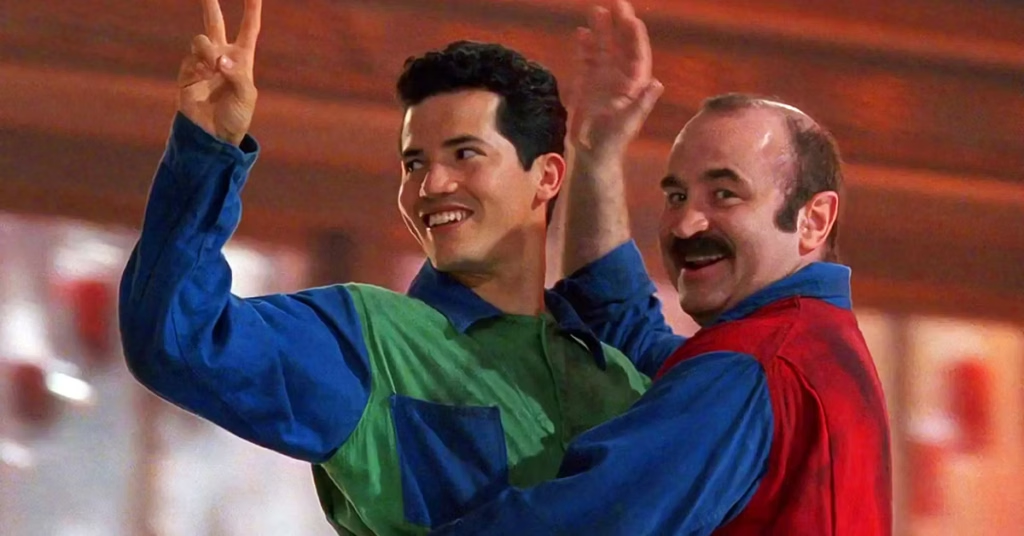
First up this week was the ‘93 Super Mario Bros adaptation, starring Bob Hoskins and John Leguizamo as Brooklyn-based plumbers Mario and Luigi. After meeting up with Daisy (Samantha Mathis), an archeological student excavating dinosaur bones from the Brooklyn sewers, the trio end up thrust into an alternate dinosaur-populated dimension, where dinosaurs and their humanoid descendants live under the cruel tyranny of President Koopa (Dennis Hopper). In order to save both dimensions, our humble plumbers will have to ascend to the heroic mantle awaiting all true warriors of the wrench and plunger.
Super Mario Bros is a messy, delightful fever dream of a production, bearing basically no resemblance to the games it’s allegedly adapting, but nonetheless offering a generous apportioning of great character actors interacting with lots of nightmarish practical-effect beasties. A film where Hoskins and Leguizamo face off with an utterly deranged Hopper can only be so bad; their performances alone make for an entertaining experience, and when you combine that with the film’s John Carpenter-meets-Terry Gilliam urban dystopia, you end up with a feature that is as generous in its incidental detailing as it is vacuous in its narrative drama. It’s the sort of film that feels destined to be panned on release and then refurbished into a cult classic; I am all for the weird, ambitious failures, and Super Mario Bros is as weird as they come.
We then checked out The End of Oak Street, the latest feature by It Follows director David Robert Mitchell. Anne Hathaway and Ewan McGregor star as parents in a fraying marriage, with McGregor lying about his employment situation while Hathaway contemplates divorce. However, all such domestic concerns are swiftly cast to the wayside when the family’s neighborhood is mysteriously thrust from 1982 into the time of the dinosaurs, and they find themselves fending off an endless array of fine-feathered and sharp-toothed new neighbors.
“What if an ‘80s suburb had to deal with a dinosaur invasion” is a charming concept for an elevated B-movie, and Mitchell offers us a reasonable progression of tense setpieces, alongside enough grizzly action to really work that PG-13 rating. That said, I don’t feel the film was improved by its attempts to Say Something; my viewing partner and I were more amused than moved by sequences that screamed “oh no, this dinosaur attack is just like our marriage,” and the ultimate payoff to the leads’ relationship felt more obligatory than earned.
With a fair amount of running time dedicated to setting up and paying off that thematic thread, the film feels smaller than it could have been. The initial promise of the neighborhood warp is a whole community under attack, and whether due to budgetary limitations or an intentional tightening of the dramatic scope, we never get the sense of apocalyptic scale that such a premise might afford. Instead, the film pretty nearly matches It Follows’ template, if not its level of scares: a small group of characters threatened by an impossible adversary, whose journey serves as a loose metaphor for a more universal thematic contagion, all decked in lovingly realized period detail. I suppose I can’t begrudge the film for being an agreeable lark, but this premise is just so juicy that I still mourn where a more ambitious script might have taken it.

Our survey of anime’s peak OVA era then continued with Genesis Survivor Gaiarth, a three-part series set in a post-apocalyptic wasteland, where humans struggle to survive among the steel bones of a lost, highly-advanced civilization. Within this devastation, young warrior Ital, “war-roid” Zaxon, and junk hunter Sahari end up drawn together by lingering ghosts of the old world, and must ultimately raise arms to protect this fragile new one.
Gaiarth is an altogether handsome production, with distinctive mechanical designs and a consistent bounty of expertly animated action. The plot is familiar and the Ital/Sahari dynamic an exceedingly tired one (he doesn’t know what romance is, she’s constantly flustered about her feelings for him), but I quite liked the series’ tonal mixture of science fiction and epic fantasy. With the world’s precursor civilization so far in the rear view, advanced technology is here treated more like magic, a framing the production accommodates with costuming and terminology that calls to mind something like Record of Lodoss War. I do wish the cast was able to rise above their archetypes, but otherwise thoroughly enjoyed this tightly scripted and beautifully animated adventure; it’s no-frills OVA comfort food, and that’s a fine thing to be.

We then returned to kaiju considerations with Rebirth of Mothra, the first entry in Mothra’s ‘90s trilogy. Directed by Okihiro Yoneda and produced by kaiju royalty Tomoyuki Tanaka, the film centers on a trio of “Elias,” tiny humanoids who are essentially standing in for the faeries of Mothra’s previous excursions. After a logging company unearths a seal guarding the terrible Desghidorah, two Elias named Moll and Lora track the emblem back to a pair of young siblings, before being attacked by their nefarious sister Belvera. As a result, Desghidorah is reborn in a fiery cataclysm, leaving it up to Mothra to once again save humanity from their own bad choices.
After watching through the recent Gamera revivals’ misguided attempts to reinvent their titular titan, it was a profound relief to watch a revival that genuinely understood its subject’s fundamental concept. Rebirth of Mothra’s main innovation on the Mothra format is making the faeries genuine lead characters, rather than just a device employed for exposition or deus ex machina. Beyond that frankly common-sense alteration, the film is a loving tribute to the Mothras of old, offering a sympathetic and extremely fluffy guardian, plenty of dramatic rubber suit action (the pyro budget alone for this one must have been extraordinary), and even a reprise of Mothra’s classic summoning songs. Mothra-centered features tend to count among the very best of Toho’s kaiju productions, and I’m happy to report that’s holding true at least through the first of these modern revivals.

from Wrong Every Time https://ift.tt/aJlIyUk
via Ai Animes 🤖